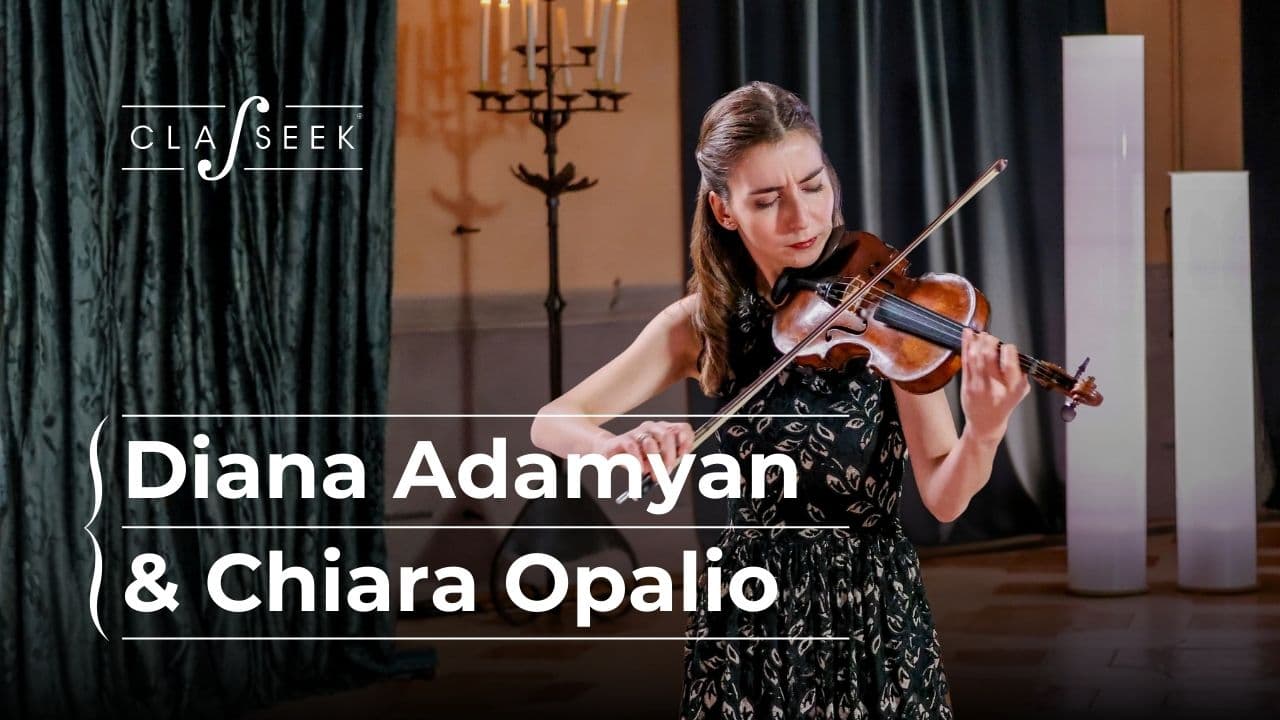
Programme
- C. Saint-Saëns - Introduction et Rondo capriccioso, Op. 28
- F. Kreisler - Liebesleid
- E. Baghdasaryan - Nocturne
- E. Elgar - La Capricieuse, Op. 17
Programme Info
The Musical Palette of Diana Adamyan
“I imagine, every time I play something, a painting of myself or I just paint in my head… I imagine colours every time I play.”
Violinist Diana Adamyan evokes vivid colours with brilliance and sensitivity, both on her violin and with her brush. Her poetic playing draws from her rich visual imagination, which she describes as ever-changing, depending on the mood, movement, and meaning. Born in Armenia, Adamyan’s unique artistry was nurtured in her musical family that filled life with colours, notes, and perfect pitch.
Camille Saint-Saëns’ was also raised with music. His great-aunt introduced him to the piano, and he displayed perfect pitch and prodigious talent before the age of three. Famed for his Danse Macabre and The Carnival of the Animals, Saint-Saëns was intrigued by the colours and rhythms of Spanish music.
His Introduction et Rondo Capriccioso, Op. 28 for violin and orchestra, described as a “fantasy waltz in the Spanish manner” by Eugène Ysaÿe, is a virtuosic staple of violin repertoire. Written in 1863 for friend and violin virtuoso Pablo de Sarasate, it sings a plaintive song. Beginning with a pensive yet spirited Andante malinconico, Saint-Saëns imbues Spanish folk idioms into his work, ending with a virtuosic Più allegro.
Virtuosity itself has evolved across generations, exemplified by Austrian-American violinist Fritz Kreisler in the 20th century. He stirred a violinistic revolution, causing the once-popular gliding portamento to slide out of style, in favour of his warm vibrato. Published in 1905, Liebesleid (Love’s Sorrow) allows the delicate quiver to shine, dancing a story of love and loss with the elegance of a Viennese Waltz.
Eduard Baghdasaryan’s Nocturne in A major holds an impassioned elegance that poignantly captures the richness of Armenian musical tradition. The violin’s wide spanned, singing melody creates an archetypal Romantic lyrical contemplation, supported by the piano’s discreet accompaniment.
Discretion transforms into coquettish play in Edward Elgar’s La Capricieuse, which delights with its virtuosic charm. Written in 1891, this miniature carries abundant whimsy in the lively rhythm of its first section, before serenading us with an expressive double-stopped melody. However, La Capricieuse prevails, as the piece closes with playful wit.
With her violin, Adamyan will paint the exhilarating range of colours that these works inspire.
Programme notes by Malika Jumbe.
Subscribe to Our Newsletter
Get the latest updates from all Classeek activities, events, and more - delivered straight to your inbox!